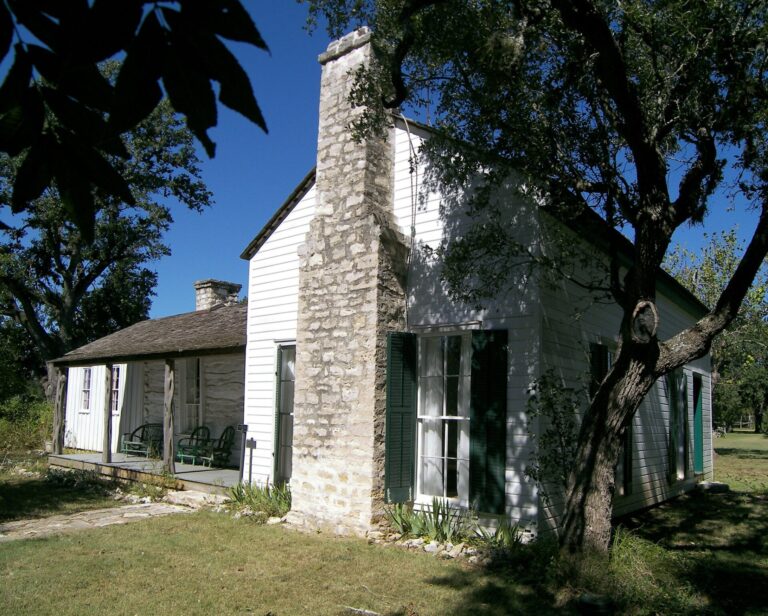
The history of Dripping Springs, Texas: the springs that named it, Dr. Pound and the first settlers, the 1881 Academy, historic Mercer Street and where to see it today.
By the Dripping Springs Info team
·
Updated November 25, 2026
·
6 min read
Photo: Nicolas Henderson, CC BY 2.0, via Wikimedia Commons
Long before the wineries and wedding venues, Dripping Springs was a cluster of farms around a spring on the road from Austin to Fredericksburg. Its story runs from a frontier doctor’s log cabin and a stone academy to a historic main street that still sets the town’s pace. Here is how a pioneer settlement became the Gateway to the Hill Country, and where that history can still be seen today.
The town takes its name from a real place. At the west end of Mercer Street, water seeps from fern-covered limestone ledges and drips into a small creek. Long before settlers arrived, the spot was a gathering place for the Native peoples who moved through this part of the Hill Country, and it became a dependable water source for the first Anglo families who farmed nearby.
It can still be seen. A granite marker sits near The Homestead at the west end of Mercer Street, and limestone steps lead down to the creek from the visitors bureau parking lot.
The first settlers
According to the Texas State Historical Association’s Handbook of Texas, the first settler in the area is thought to have been a man named Fawcett, who arrived about 1849. Other families began farming the valleys of Little Barton and Onion creeks in the early 1850s, drawn by good water and rich soil. In 1857 Dripping Springs opened what became a permanent post office, an early sign that the scattered farms had become a community.
Life on this frontier meant living alongside the Native peoples of the region. The Pound House Museum notes that a Comanche and Kiowa trail ran just southeast of the Pound property, and that Dr. Joseph Pound kept a close relationship with the local Tonkawa.
Dr. Joseph and Sarah Pound
No family shaped early Dripping Springs more than the Pounds. Joseph M. Pound (1827 to 1914) first came to Texas at 19 to fight in the Mexican War, returned to Kentucky to earn his medical degree in Louisville, and came back with his wife, Sarah, settling here in 1853. In 1854 and 1855 they built a two-room log cabin with a dogtrot breezeway between the rooms.
Their home became the community’s clinic and hospital, and at various times its church, schoolhouse and gathering place. During the Civil War, Dr. Pound served as a surgeon, caught scarlet fever and was sent home; after recovering he joined a frontier regiment. The Pounds raised seven children to adulthood on the farm, and four generations of the family lived there for 130 years, until 1983. They never modernized it: electricity arrived in 1947, and indoor plumbing never did.
Sarah brought cuttings of antique roses from her native Mississippi in 1853, and they still bloom in the garden beside an oak the museum estimates at more than 500 years old.
The restored farmstead is now a museum inside Founders Memorial Park, with the original log house, barn, smokehouse, windmill and cistern, and a collection that is about 90 percent the family’s own belongings. It has been a Recorded Texas Historic Landmark since 1965, was added to the National Register of Historic Places in 1995, and opened as a museum on May 4, 2003. Hours are limited and tours can be arranged by appointment, so check the museum’s website before visiting.
Location made Dripping Springs last. It sat on the road between Austin and Fredericksburg, and as traffic grew, so did the town. By 1884 it had several businesses, including a steam gristmill and a cotton gin, and about 130 residents.
Churches and their burial grounds followed. Early settlers John and Nancy Phillips deeded land to the Methodist Episcopal Church, and a small church was dedicated on March 13, 1880. Many early settlers and sixteen Civil War veterans are buried in what is now called Phillips Cemetery. When the congregation built a new church on the Old San Marcos Road, now Ranch Road 12, in 1901, the original building was sold and moved, and the site remained a cemetery.
Dripping Springs Academy
The Dripping Springs Academy building, founded in 1881. Photo: Larry D. Moore, CC BY 4.0, via Wikimedia Commons.
Education arrived early. The Dripping Springs Academy was founded in 1881 by W. M. Jordan, a noted Baptist preacher. Its stone building was given to the Pedernales Baptist Association in 1883 and to the public school district in 1889. A second floor was added in 1920, and in 1952 the building became the property of Rambo Lodge No. 426, A.F. & A.M. It was named a Recorded Texas Historic Landmark in 1967. The building is privately owned today, so admire it from the street.
Mercer Street
A historic limestone storefront on Mercer Street. Photo: Larry D. Moore, CC BY 4.0, via Wikimedia Commons.
Mercer Street was home to many of the town’s first businesses, and many of its buildings date from about 1870 to 1940. Limestone storefronts and old homes now house restaurants, bakeries, shops and music venues, but the scale of the street has hardly changed.
On July 17, 2013, the Dripping Springs Downtown Historic District was listed on the National Register of Historic Places. It covers the 100 to 500 blocks of Mercer Street, along with parts of Wallace, San Marcos and College streets and Old Fitzhugh Road.
From farm town to city
Like much of rural Texas, Dripping Springs lost population during the Great Depression. But it remained the principal town of northern Hays County, and after World War II it grew slowly and steadily. By the mid-1980s it had about twenty businesses and more than 600 residents. The town incorporated in 1981, passed 1,000 residents by 1990 and reached 1,548 by 2000, according to the Handbook of Texas.
The modern era
The last few decades brought the identity Dripping Springs is known for now. Its early outdoor lighting rules led to its designation in February 2014 as the first International Dark Sky Community in Texas. The Texas Legislature named it the Wedding Capital of Texas in 2015, again in 2017, and again in 2025. Wineries, breweries and distilleries have grown up along Fitzhugh Road, Bell Springs Road and the roads into Driftwood.
Growth has been fast. The 2020 census counted 4,650 people inside the city limits, and many more live in the surrounding hills. The town still celebrates its roots every April with the Founders Day Festival on Mercer Street.
See the history in person
The dripping springs: follow the limestone steps down to the creek from the visitors bureau lot at the west end of Mercer Street.
The Pound House: tour the 1850s farmstead in Founders Memorial Park. Check hours first.
Mercer Street: walk the historic district, then stop for coffee at Mazama or a pint at Acopon Brewing.
Dripping Springs Academy: see the 1881 stone building from the street.
Founders Day: visit in late April for the town’s biggest festival.
Questions visitors ask
How did Dripping Springs get its name?
From the springs at the west end of Mercer Street, where water drips from fern-covered limestone ledges into a creek. The spot was a gathering place for Native peoples and a water source for early settlers.
When was Dripping Springs founded?
The first settler arrived about 1849, families were farming the area by the early 1850s, and the post office opened in 1857. The city incorporated in 1981.
Who was Dr. Joseph Pound?
A frontier doctor who settled here with his wife, Sarah, in 1853. Their log home served as the area’s clinic, church and school, and it is now the Pound House Farmstead museum.
Is downtown Dripping Springs historic?
Yes. The Dripping Springs Downtown Historic District, centered on Mercer Street, was listed on the National Register of Historic Places in 2013.
Is the Pound House open to visitors?
Yes. The farmstead museum is in Founders Memorial Park. Hours are limited, and tours can be arranged by appointment through the museum.
Sources: Handbook of Texas Online (Texas State Historical Association), Pound House Farmstead and Museum, Texas Historical Commission markers, National Register of Historic Places, and Destination Dripping Springs.